In the early 1980s, two entomologists working beside a road in Western Australia noticed something odd about a discarded beer bottle. Male jewel beetles were clinging to it, trying to mate with it. The males had evolved a simple rule for finding a partner: look for something large, brown, glossy and dimpled.
A short, squat “stubby” beer bottle fitted that description better than any real female, and the males wouldn’t let go. Some died in the sun or were eaten by ants rather than give up, and the study later won an Ig Nobel prize. The beetles weren’t doing anything wrong. They were following a rule that had always worked, until the world changed around them.
Companies fall into the same trap all the time. The way out feels uncomfortable to anyone running a business, because it means being a little less efficient on purpose: run a deliberately mixed set of strategic plays rather than one big bet, and stop short of squeezing every last drop out of what’s already working. Biologists call the ability to change when conditions change plasticity, and in nature and business alike, a bit of sloppiness is what keeps it alive.
What nature tells us
Specialisation is a bet that tomorrow will look like today. When the bet pays off, specialists win, because they exploit their niche better than any generalist can. When it doesn’t, they have little to fall back on, because generations of selection have stripped out the variation they would need to adapt.
Two pairs of animals, each sharing the same patch of ground, show how this plays out.
Two butterflies in the same wood
The High Brown Fritillary and the Comma are both orange-and-brown woodland butterflies, and both like the sunny clearings and edges of English woods. The High Brown was once widespread, but it’s a specialist: its caterpillars feed only on violets, and only violets growing somewhere very warm, typically among dead bracken in coppiced woods and grazed hillsides.

As coppicing and traditional grazing died out, those warm patches disappeared. The High Brown has declined in distribution by 96% and is now the UK’s most threatened butterfly, hanging on in a handful of places such as Exmoor, Dartmoor and Morecambe Bay.
The Comma came close to the same fate. In the 1800s its caterpillars leaned heavily on hops, and probably because hop farming declined, it shrank back to a small area along the Welsh border. Then it switched to stinging nettles, which grow almost everywhere, and spread back across England and Wales and into Scotland, probably helped by a warming climate. The ability to live on nettles had been there all along. It just hadn’t been needed.
A grouse and a deer in the same forest
The capercaillie, the world’s largest grouse, lives in the old pinewoods of the Scottish Highlands. Its chicks hatch in June and need to find insects in the undergrowth, so wet weather around hatching badly cuts breeding success. Predators take their toll too, as do the fences put up to keep deer out of young forests, which adult birds fly into. Numbers have fallen sharply since the 1970s, and the bird is now at real risk of disappearing from Britain altogether.
Red deer share the same woods and hills, and they eat almost anything: grass, sedges, heather, bilberry, young trees and bark. Scotland now has an estimated 360,000 to 400,000 of them, so many that their browsing holds back the regrowth of the native pinewoods the capercaillie depends on. The generalist is thriving, and its success is making life even harder for the specialist.
Nature’s better answer
The winners aren’t usually pure generalists either. A species that’s average at everything gets outcompeted when conditions are stable. Nature’s more common answer is to specialise, but to keep something in reserve.
Desert annual plants hold back a share of their seeds every year, leaving them dormant even when conditions look good. In a good year that looks wasteful. In a drought, those seeds save the population.
Ants follow scent trails laid by other ants to find food, but they don’t follow them perfectly. Models of ant foraging suggest this is useful: when food is scattered across several places, a colony whose ants sometimes wander off the trail forages more efficiently, because the wanderers find new food. Honeybees do something similar on purpose. Some bees keep scouting for new flowers even when the colony is well fed, so when a known patch runs dry, the colony already knows where to go next.
And populations carry traits that do nothing useful today, like the Comma’s ability to live on nettles. That hidden reserve is what a species draws on when conditions change. In nature, a little inefficiency is the price of being able to adapt.
How companies fall into the same trap
Companies specialise for the same reason species do: it works. Focusing on one product, one market and one way of selling usually brings better margins and faster growth than spreading yourself thin. The catch is that every round of optimisation makes you a little better at today and a little worse at changing.
Researchers have names for this. The “competency trap” is when you get so good at your current way of working that new approaches always look worse by comparison, so you never build skill in them. The “success trap” is when strong results reinforce the formula, so you keep doubling down right up until the world shifts.
The organisational theorist James March described the underlying problem in a famous 1991 paper. Organisations get better at exploiting what they already know much faster than they get better at exploring, which tends to make them “effective in the short run but self-destructive in the long run”.
| In nature | In a company | What it looks like day to day |
|---|---|---|
| Fit to a single niche | Single-product, single-market focus | Hiring, systems, targets and processes all tuned to one product and one type of customer |
| Losing hidden variation | Shedding capabilities | Cutting R&D and “non-core” teams, and hiring the same profile every time |
| Fit to a single timetable | Moving slower than the market | Planning and decision cycles that are slower than the changes happening around you |
| Fit to a single signal | Trusting measures that used to mean health | Strong margins on a declining product read as proof that all is well |
| Depending on a single host | Depending on one platform, channel or partner | One partner’s decision could hit most of your business overnight |
Some well-known business stories follow the same script:
- Kodak built its business around film, and one of its own engineers built the first digital camera in 1975. By his account, management’s reaction was to keep it quiet, because it threatened the film business. Kodak did go on to make digital cameras, but rivals made the running, and it filed for bankruptcy in 2012.
- Fujifilm faced the same collapse but asked what it was really good at underneath the film. It took its know-how in collagen, a key ingredient of film, and the chemistry it used to stop photos fading, and turned them into a skincare range called Astalift, alongside a bigger move into pharmaceuticals.
- Nokia’s Symbian software was built for efficient phones with physical buttons, which made it brilliant in one world and very hard to rebuild for touchscreens and apps. By 2009 Nokia was juggling 57 different, incompatible versions of it. Apple, meanwhile, ran one system across its iPhones and let outside developers fill it with apps.
- Blockbuster’s model depended on store leases and late fees, and late fees made up a big share of its profit, so giving them up felt impossible. In 2000 it turned down the chance to buy a small DVD-by-post company called Netflix for $50 million. Netflix thought of itself as a way of getting films to people, so moving from posted DVDs to streaming to making its own shows was a change of method rather than identity.
None of these companies were stupid. They were optimising correctly for the world they had, and the signals telling them they were doing well were the same signals that stopped them seeing the shift. Like the beetles, they were following a rule that had always worked.
Why you need more than one strategic play
Even if you’re very clear about your core business, you can’t know which shift is coming. So run several strategic plays at once, sized very differently, rather than putting everything behind one.
A useful way to think about it is three tiers:
| Tier | What it is | Share of effort | How you judge it |
|---|---|---|---|
| Core | Making today’s products, customer experience and sales better | The large majority | Growth, retention, margin and efficiency |
| Adjacent | Taking what you’re good at to a neighbouring market, customer or product | A meaningful minority | Early traction against clear milestones |
| Exploratory | Small, cheap bets on things that might matter in a different world | A small, protected slice | What you learned, and whether it earned the next round |
The best-known version of this idea comes from research by Bansi Nagji and Geoff Tuff. They found that companies which outperformed their peers typically split their innovation investment roughly 70/20/10 across core, adjacent and transformational work, and that long-term returns ran the other way round, with around 70% coming from the smallest, transformational slice. The right mix varies by industry, but the principle holds: the smaller tiers need protecting, or they get raided every time the core needs a bit more.
Each exploratory play works like a cheap option. It costs a little now and buys you the right to move faster later if the world goes that way. Most options expire worthless, and that’s fine, because their value lies in the few that don’t.
Different plays also build different capabilities. Every adjacent or exploratory bet teaches you something you’d never learn by doing the core better, such as how a new kind of customer buys or how a new technology behaves. That’s a company’s version of the Comma’s taste for nettles.
And a spread of plays protects you from a single point of failure. If your fortunes ride on one product, one channel or one big partner, you’re one decision away from being a specialist that has lost its only food source.
How Microsoft kept its options open
Microsoft’s early history shows what running two plays at once looks like. In 1985 it signed a deal with IBM to jointly build OS/2, the planned successor to DOS, the basic software that ran most personal computers at the time. Bill Gates believed OS/2 was destined to become the most important operating system ever, and it was the official, partner-backed bet.
Alongside it, Microsoft kept working on Windows, its own point-and-click layer that sat on top of DOS. Early versions were underwhelming, but so was OS/2, which arrived in 1987 slow, demanding and short of software to run on it. In 1988 Microsoft added a third option, hiring the engineer Dave Cutler to build a new version of OS/2 that Microsoft itself would control.
Then Windows 3.0 launched in 1990 and became a huge hit, eventually selling around ten million copies. Microsoft and IBM went their separate ways: IBM kept OS/2, and Microsoft kept Cutler’s work, which became Windows NT and, in time, the foundation of every version of Windows since XP. Meanwhile rival software makers such as Lotus and WordPerfect had backed OS/2 rather than Windows, which gave Microsoft’s own programs a head start.
It’s debatable how deliberate all this was, and Microsoft certainly didn’t predict the winner. What it did was keep more than one play alive long enough to see which way the market was going, then move decisively. That wasn’t free: the split soured one of the most important partnerships in the industry, and partners tend to notice when you’re hedging against them.
The case for sloppy optimisation
Sloppy optimisation means improving what works until it’s good enough, then deliberately stopping short of perfect. Keep pushing your core business forward, but not by stripping out every bit of slack: the spare time, money, people and odd capabilities that aren’t fully committed to today’s plan.
The danger lives in the last stretch. The first big gains usually come cheaply. The last few percent tend to come from removing buffers, standardising people and processes, and cutting anything that doesn’t serve today’s model, which is exactly what strips out your ability to adapt.
Think of a student who prepares for an exam by memorising every past paper. They’ll do brilliantly if this year’s questions look like last year’s, and badly if they don’t. Data scientists call this overfitting, and a company tuned too precisely to its current market has the same problem.
Slack is also where new things grow. Intel’s move from memory chips to microprocessors in the mid-1980s is usually told as a bold leadership call, with Andy Grove asking Gordon Moore what a new CEO would do in their shoes. But Grove himself credited middle managers, whose day-to-day decisions had been shifting factory capacity towards processors before the top team made it official.
And like the wandering ants, a team that sometimes does things differently (tries a new kind of customer, prices differently, runs a process another way) learns things that a perfectly disciplined team never will.
How much slack you carry should depend on how fast your world is moving. In a stable market, tight optimisation wins. In a fast-moving one, it’s the quickest route to becoming someone else’s case study.
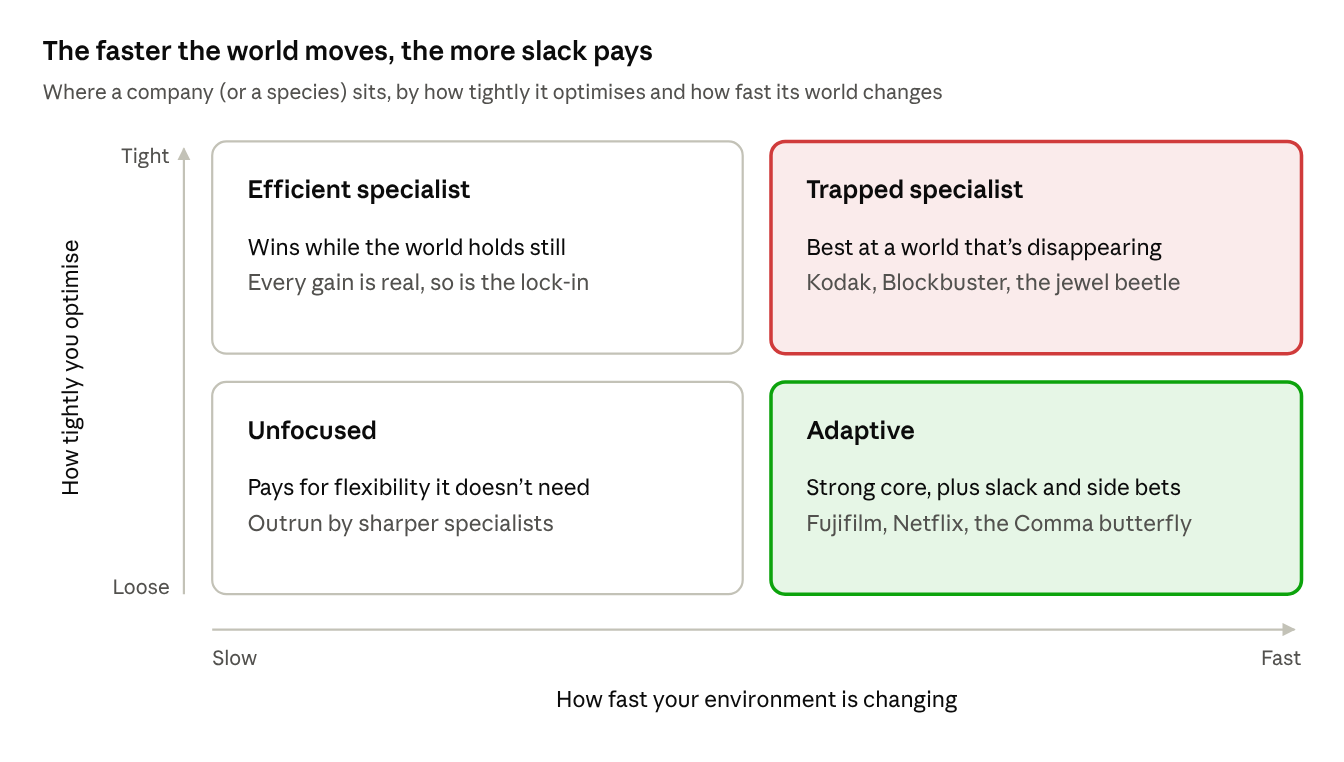
AI is pushing a lot of industries towards the right of this chart, not just software. If yours is one of them, you should probably be moving down it too, keeping the core strong while loosening your grip on how perfectly it’s tuned.
What this looks like in practice
None of this needs a reorganisation, just a few habits that stop the core from quietly absorbing everything else.
Running a diverse set of plays:
- Make the portfolio visible. List your current plays by tier, each with an owner and a rough share of effort. If everything turns out to be core, that’s the finding.
- Ring-fence the smaller tiers. Give adjacent and exploratory work a protected budget and people who aren’t pulled back the moment the core has a bad month. O’Reilly and Tushman’s research found that established companies do this best by keeping new, exploratory units separate from the core while joining them up at the top.
- Fund in stages. Small money to test an idea, more once it hits clear milestones, and an agreed point where you stop. This keeps exploration cheap and stops projects lingering on with no real future.
- Judge exploration on learning, not revenue. Early bets measured against core metrics will always lose, so ask what you learned and whether it earns another round.
Keeping plasticity in the core:
- Optimise to good enough. When a team proposes squeezing the next few percent out of a process, ask what flexibility it costs, not just what it saves.
- Leave some capacity unplanned. 3M’s 15% time and Google’s 20% time are the famous versions, credited with things like Post-it Notes and Gmail. Yours doesn’t need to be that big or that formal; a small slice of time for experiments, fixing annoyances and following hunches is enough.
- Hire and keep for range. Bring in people with different backgrounds and ways of thinking, and protect the slightly awkward capabilities that don’t fit today’s model but might matter tomorrow.
- Watch outward-looking signals. Pair each metric that tells you the core is healthy with one that tells you whether the ground is moving, like where new buyers come from, what your customers are starting to do without you, or which competitors are winning deals they shouldn’t.
- Build a plasticity check into your regular business reviews. Once a quarter, look at the portfolio mix, what the exploratory bets taught you, and which core assumptions would hurt most if they turned out to be wrong.
Where this goes wrong
Plasticity is easy to argue for and easy to abuse. These guardrails keep it from turning into drift:
- Strategy is still about choosing. A diverse set of plays isn’t permission to say yes to everything. Twenty exploratory projects usually means nobody has really chosen, and a handful of well-chosen bets beats a scatter of underfunded ones.
- Sloppy isn’t careless. Security, reliability, customer data, compliance and financial controls should stay tightly run. Slack belongs in how you find the next thing, not in whether the current thing works for your customers.
- Every bet needs an end point. Each exploratory play needs a moment where you decide to scale it, fold it into the core, or stop. Without that, slack becomes cost and the core pays for it.
- Generalists lose when things are stable. If your market really isn’t moving, heavy hedging is just expense. The amount of slack you carry should be a conscious choice that you revisit, not a permanent setting.
- Watch out for innovation theatre. Hack days and innovation weeks that never connect to resourcing decisions give the feeling of plasticity without the substance. The real test is whether an exploratory bet can ever win budget from the core.
Questions to test your strategy against
These questions are a quick way to see how much plasticity you have today. They work best asked out loud, by people who aren’t defending the plays being discussed.
| Question | Warning sign | Healthy sign |
|---|---|---|
| How many distinct plays are you running, and how is effort split between them? | Everything is core, or effort quietly drains out of the smaller tiers | A clear mix, with the smaller tiers protected |
| What capabilities have you cut or let fade in the last two years? | You can’t name any, or nobody asked what you lost | You know what you’ve let go, and chose it on purpose |
| How much of your fate rides on one platform, channel or partner? | A single change by one partner would hit most of your revenue | You understand the dependency and have at least one hedge |
| If AI took over a big chunk of the work your customers pay you to help with, which of your strengths would still matter? | You haven’t seriously asked | A small bet is already testing it |
| Can you change course faster than your market changes? | You find out about shifts from lost deals | You spot shifts in time to test a response |
| Which of your health metrics could be misleading you? | You’ve never asked | Each core metric is paired with an outward-looking one |
| When did an exploratory bet last win budget from the core? | Never, or nobody can remember | Recently, and you can name it |
| Who in your leadership team owns the question of a different future? | Nobody, or everybody, which amounts to the same thing | A named person, with a regular slot in your business reviews |
Closing thought
The species that survive big shifts are rarely the ones best suited to the old world. They’re the ones that kept a few options open, even when it looked inefficient. Be very good at what you do today, and deliberately a little less than perfectly optimised for it, because that gap is what lets you become something else when you need to.
Or, to put it more simply: don’t be the beetle on the bottle.
Further reading
- James March, “Exploration and exploitation in organizational learning”, Organization Science (1991). The classic on balancing new and existing work.
- Charles O’Reilly and Michael Tushman, “The ambidextrous organization”, Harvard Business Review (2004). How established companies run core and exploratory work side by side.
- Bansi Nagji and Geoff Tuff, “Managing your innovation portfolio”, Harvard Business Review (2012). The source of the 70/20/10 split.
- A summary of Andy Grove’s Only the Paranoid Survive, including Intel’s exit from memory chips.
- Bet-hedging with seed banks, from the University of Arizona’s Desert Laboratory.


Leave a Reply